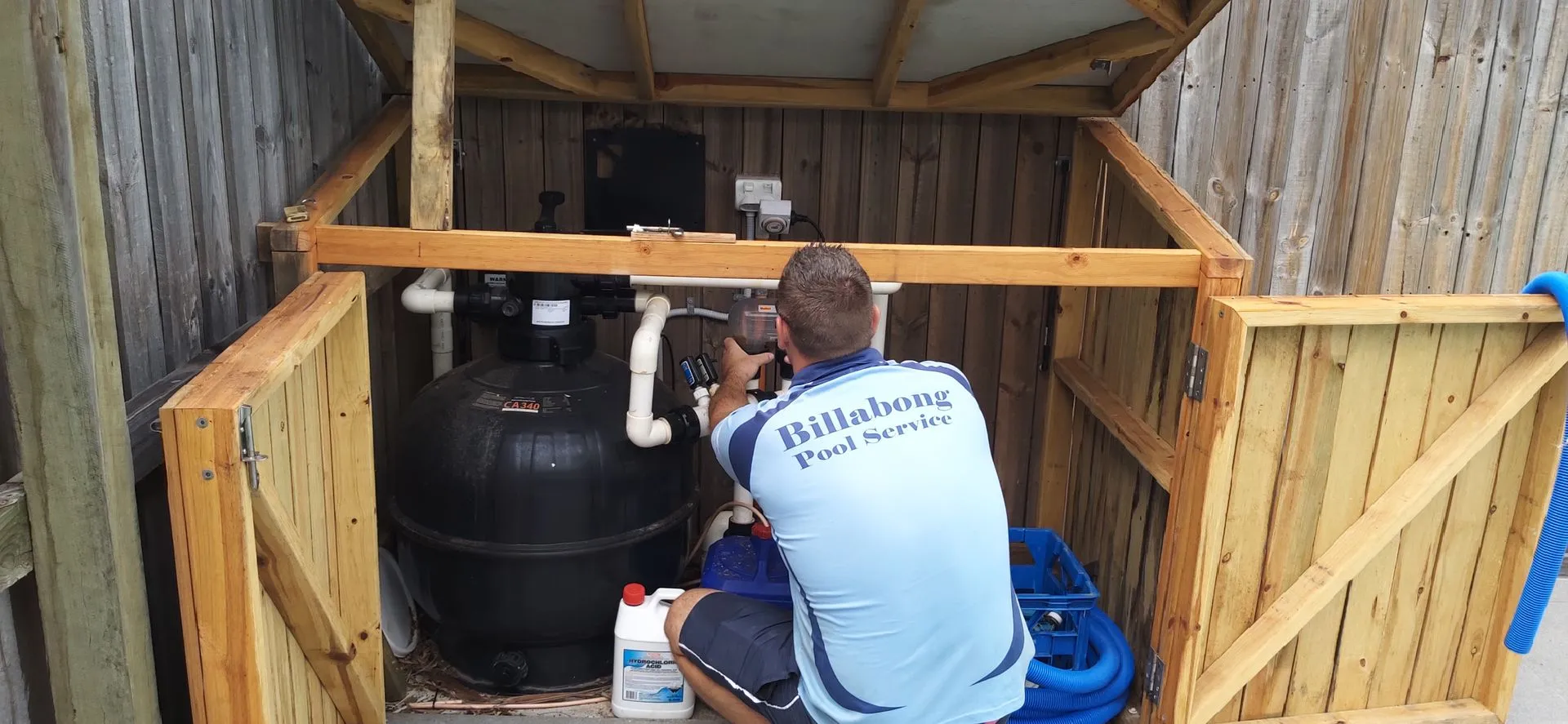
A back-yard salt pool behind a Baringa home, with the equipment enclosure visible along the fence line

Pool Cleaning in Baringa

Sunshine Coast Region, QLD

Baringa's first pools are old enough to need decisions

Salt and mineral pool servicing, cell care and honest advice on what your pool costs to run

Baringa was the first suburb of the Aura development — land sales opened in August 2016, homes were occupied from 2017, and the locality was formally gazetted on 18 August 2017 out of Bells Creek. By the 2021 Census it had 4,604 residents. That history is the reason this page reads differently from the newer Aura suburbs: Baringa's earliest pools are now approaching a decade old, which is exactly when salt cells, pumps and running costs stop being somebody else's problem.

Most pool advice written for new estates assumes the pool is new. In Baringa that stopped being true a while ago. The first wave of homes here went up from 2017, so the original salt cells are reaching the end of their plate life, pump bearings are making noises they did not make in year one, and owners have had enough quarterly power bills to form opinions about what the pool costs.

That is the conversation this suburb tends to want, and it is a different one from the conversation in Nirimba or Gagalba. It is also a conversation about salt and mineral systems specifically, because that is what is in the ground here. Both types are excellent when the underlying chemistry is right, and both fail expensively when it is not — and the failure almost always presents as an equipment problem long before anyone suspects the water.

Local knowledge

Why it matters here

Scale is the mechanism that ties the two together. In a salt or mineral system, calcium hardness and drifting pH deposit scale on the chlorinator's plates. The cell then has to work harder to hit its rated output, and working harder is what shortens its life. By the time the owner notices — chlorine that will not hold, an error light, a cell that has to run at maximum — the damage has been accumulating for a year or more, and the invoice is for a cell rather than for a bottle of acid.

Salt pools also drift alkaline as a matter of course. That is not a fault; it is how the chemistry works. But it means pH has to be actively corrected on a schedule rather than watched, and stabiliser has to be held in a band that is high enough to carry chlorine through summer UV and low enough that the sanitiser still does its job. Get those two right and a cell lasts the years it is supposed to. Get them wrong and it does not.

The running-cost question is the other half. Pool equipment is often among the larger electrical loads in a Baringa home, and a single-speed pump left on a builder's default schedule is frequently running longer each day than the pool's actual turnover requires. Working out what that requirement is costs nothing and changes the bill without buying anything. Where a replacement genuinely is due, the numbers on a variable-speed pump and its payback period are worth seeing before deciding — including when the payback does not stack up.

On the ground here

Common local challenges

The challenge

A salt cell that dies years early

Why it happens

Calcium hardness and drifting pH coat the cell's plates with scale. The cell overworks to reach its output, and the plates give up before their time.

Why it matters

Nine times out of ten a cell replaced at four or five years was a chemistry problem, not a manufacturing one — and it is the most expensive avoidable item on a salt pool.

How we help

The cell is inspected for scale every visit and descaled when it needs it, and calcium hardness and pH are corrected rather than simply recorded. Keeping those two in range is cheaper than a cell by a wide margin.

The challenge

Salt levels drifting below the chlorinator's band

Why it happens

Salt is lost through backwashing, splash-out and rain dilution, and it is easy not to notice because the pool still looks fine.

Why it matters

A chlorinator run below its rated salt range works harder for less output and shortens its own life doing it — the same failure mode as scale, arriving by a different road.

How we help

Salt and mineral levels are held inside the manufacturer's band for the system you actually have, and topped up before the unit starts compensating rather than after.

The challenge

Mineral systems managed as though they were salt pools

Why it happens

The two look similar to an owner and are often described interchangeably, but their target ranges and top-up schedules are not the same.

Why it matters

Applying salt-pool assumptions to a mineral pool is where owners come unstuck — the readings look defensible and the system still degrades.

How we help

We service to the parameters of the system installed, and will tell you plainly which one you have and what its ranges are, so you are not maintaining someone else's pool.

The challenge

Pumps running longer than the pool needs

Why it happens

Builder-set run times are defaults, not calculations, and they rarely get revisited once the house is lived in.

Why it matters

Pool equipment is often among the larger electrical loads in the house, and hours the pool does not need are money that buys nothing.

How we help

We work out the pool's actual turnover requirement from its volume and the pump's flow rate and set run times to match. That change frequently costs nothing at all.

The challenge

First-wave equipment reaching the end of its life at the same time

Why it happens

Baringa's earliest homes were occupied from 2017 and were built in waves, so the equipment in a street tends to age together.

Why it matters

Failures cluster, and an owner facing a cell, a pump and a filter in one season needs to know which is genuinely urgent.

How we help

When something is near the end we say so, in order, with what it will cost to run in the meantime — including when the honest answer is that it has another season in it. Where a replacement is due we will give you real numbers and the payback period, and say so if the payback does not stack up.

The challenge

Shared and community pools held to a different standard

Why it happens

Baringa's town-centre precinct includes shared facilities alongside private homes, and a shared pool has to be correct every day rather than on service day.

Why it matters

Committees and managers need consistent testing records and prompt storm response, not just a clean pool.

How we help

We service private and shared pools on the same Caloundra branch route, and provide reporting a committee or manager can act on. Shared pools stay on a weekly schedule year-round regardless of season.

What we do

Services on this run

Salt and mineral pool servicing

Scheduled servicing built around the system you have — cell inspection and descaling, salt or mineral levels, calcium hardness, pH and stabiliser.

Salt pools drift alkaline as a matter of course, so pH here gets corrected on a schedule rather than watched. That is what keeps a cell alive to its rated life.

Book a service

Chlorinator cell care and replacement

Cell inspection, descaling, and replacement advice when the plates are genuinely done.

Baringa's first homes were occupied from 2017, so original cells are now at the age where scale decides whether they last. Most early failures we see are chemistry, not the cell.

Ask about your cell

Pump run times and running-cost review

Turnover calculation from your pool volume and pump flow rate, with run times set to match.

Builder-set run times are defaults, not calculations. Correcting them frequently saves money without buying anything.

Review my running costs

Pool pump repairs and replacement

Repair of pumps and motors, plus real numbers and payback periods on a variable-speed replacement when one is due.

Equipment in a Baringa street tends to age together. We will tell you which item is genuinely urgent and which has another season in it.

Book a pump repair

Community and shared pool servicing

Servicing for shared and community facilities, with testing records and reporting a committee or manager can act on.

Baringa's town-centre precinct has shared facilities alongside private homes. Both sides of the suburb run on the same weekly pass.

Talk to us about a shared pool

Pool shop and water testing at 134 Bulcock Street

Over-the-counter water testing with a dosing plan, plus chemicals, cells, parts and equipment.

Bring the make of your chlorinator with the sample. The right dosing plan for a mineral system is not the right one for a salt system.

Visit the Caloundra shop
Who does the work

Credentials and cover

Billabong Pool Service & Supply publishes ABN 63 010 047 239 and QBCC Licence No. 69021 in its own site footer. The nearest counter to Baringa is the Caloundra branch at 134 Bulcock Street, Caloundra QLD 4551 on (07) 5438 1588, trading Monday to Friday 8:00am–4:30pm and Saturday 8:00am–12:00pm — a counter that will read a water sample and hand back a dosing plan. Billabong does **not** issue pool safety certificates and does not perform pool safety inspections; that is a licensed pool safety inspector's work, under QBCC rules.

Pricing

What we list

Where to find us

Three shopfronts on the Sunshine Coast

Good to know

Frequently asked questions

My salt cell is only four years old and it is already failing. Why?

Nine times out of ten it is scale. High calcium hardness and drifting pH coat the plates, the cell overworks to reach its rated output, and the plates give up early. Regular inspection and correct water chemistry cost considerably less than a cell — which is why cell inspection is a named step on every visit here rather than something done when there is a problem.

Is a mineral system harder to look after than salt?

Not harder, just different. The target ranges and the top-up schedule are not the same, and applying salt-pool assumptions to a mineral pool is where owners come unstuck. We service to the parameters of the system you actually have, and will tell you plainly which one that is.

How long should my pump actually run each day?

It depends on your pool's volume and your pump's flow rate, not on a rule of thumb. We work it out on the first visit. Builder-set run times are defaults rather than calculations, and correcting them often costs nothing at all.

Is a variable-speed pump worth it for my pool?

Sometimes, and we will show you the numbers rather than the sales pitch — what the current pump costs to run, what a replacement would save on your pool, and how long the payback takes. If the payback does not stack up for you, we will say so.

We look after a shared pool in the Baringa town-centre precinct. Can you service it?

Yes. Shared and community pools need consistent testing records, prompt storm response and reporting a committee or manager can act on, and they should stay on a weekly schedule year-round regardless of season. We run them on the same Caloundra branch route as the private pools in the suburb.

How often should a private Baringa pool be serviced?

Weekly through the swimming season and fortnightly through winter suits most private pools here. Shared and community pools are the exception — weekly, all year.

Next step

If you want to know what your pool actually costs to run — and what it should not — that is a conversation worth having before the next cell fails. Call the Caloundra branch on (07) 5438 1588, or send the details through the contact form. Bring the pool's dimensions and, if you have it, the make of your chlorinator; those two things settle most of the questions on the first visit.

References

Sources

ABS 2021 Census QuickStats — Baringa (Qld) SAL301594,604 residents at the 2021 Census; median age 29; 83.0% separate houses among occupied private dwellings; 45.3% owned with a mortgage; 11.4% owned outright; average household 3 people
Baringa, Queensland — WikipediaBaringa gazetted 18 August 2017, excised from Bells Creek within the Caloundra South Priority Development Area; first residential land sales August 2016 with homes occupied from 2017; first suburb of the Aura development
Billabong Pool Service & Supply — site footerABN 63 010 047 239; QBCC Licence No. 69021; Caloundra branch 134 Bulcock St, (07) 5438 1588; trading hours