The challenge
The Pool Chemical Supplies Alexandra Headlands Pools Need Most
Why it happens
Why it matters
How we help
Pool Chemical Supplies in Alexandra Headlands: Right-Sized Stock for Small Pools and Older Systems
Most pools at Alexandra Headlands are small — courtyard pools behind older walk-up unit blocks along Alexandra Parade, and compact backyard pools on the slope up toward the bluff.
Small pools swing hard: a dose that suits a big backyard pool will overshoot a 15,000-litre courtyard pool and cost you a week getting it back.
Our pool chemical supplies in Alexandra Headlands are sold to a tested result and a calculated dose, in quantities that suit the pool you actually have. Free water testing, honest advice, and no upselling drums you can't store.
Alexandra Headlands sits directly on the open coast between Maroochydore and Mooloolaba, without the harbour shelter one has or the river mouth of the other. Its pools are mostly small and often decades old — a legacy of the low-rise unit blocks built along the beachfront through the 1960s to 1980s, many with a modest shared pool and a sand filter that has been there almost as long.
Two things follow: the water balance moves fast because the volume is small, and the equipment is often working below spec. That's why our pool chemical supplies in Alexandra Headlands come with a test result attached. Correcting a small pool is a matter of precision, not volume, and adding more product to a struggling filter rarely fixes anything.
Alexandra Headlands is a narrow, exposed suburb: a long beachfront running below Alexandra Parade, the headland and bluff at its southern end, and a short residential slope rising behind. It was one of the earlier parts of the coast to be developed for holiday accommodation, and much of that housing stock is low-rise unit blocks from the 1960s through 1980s rather than modern towers. Noticeably, most of their pools are small — a shared courtyard pool for a block of eight or twelve units, or a compact private pool squeezed onto a residential lot.
Small volume is the defining technical fact. A 15,000-litre pool reacts to a dose roughly three times as strongly as a 45,000-litre one, so an owner following a generic label instruction routinely overshoots. Alkalinity is the first casualty: it gets stripped by repeated acid dosing and by rain dilution, and once the buffer is gone the pH swings wildly and chlorine stops holding. We see this cycle constantly from this suburb.
The second factor is age. Sand filters installed with those older blocks are often decades past a media change, so they pass fine particulate straight back into the pool — the water looks dull no matter how much chlorine goes in. And because the suburb faces open ocean with little shade or shelter, UV and salt-laden wind add to chlorine loss and equipment wear on top of it.
Our approach is deliberately conservative. We calculate doses against the real volume and correct alkalinity before chlorine, so the pool stops bouncing. We ask how old the filter is before recommending a clarifier, because clarifier on dead sand is money wasted. And for committees managing a shared pool on a volunteer basis, we'll write the routine down as a simple weekly sequence anyone can follow.
Liquid, granular and tablet chlorine in retail sizes that a small pool will actually use before it degrades. Granular holds its strength longer than liquid in a domestic shed, which matters if your pool only needs a modest dose each week. Best for owner-maintained courtyard and backyard pools.
Buffer, acid and soda ash — the products that stop a small pool bouncing. Low alkalinity is the single most common reading we correct for Alexandra Headlands customers, because small volumes lose their buffer quickly to rain dilution and repeated acid dosing, and everything else becomes unstable once it's gone.
Calcium raiser for pools where the reading has dropped too low. It matters here because many Alex pools are older concrete or pebble finishes, and soft water etches the surface over time. It's a slow, invisible cost that a routine test picks up before the damage shows.
Cyanuric acid to protect chlorine from the strong, unshaded UV on this stretch of open coast, plus pool salt and cell cleaner for salt-chlorinated systems. Suits anyone whose chlorine reading vanishes between weekly tests despite dosing correctly.
For pools where an ageing sand filter no longer polishes the water properly. Clarifier helps in the short term, but we'll also tell you if the real answer is a media change — see pool repairs or ask about filter servicing.
Pool repairsA lot of the people buying chemicals for Alexandra Headlands pools aren't professionals. They're owner-occupiers, and volunteers on small body corporate committees who ended up responsible for a shared pool without ever asking to be. What they need isn't a bigger bottle — it's someone to tell them what the numbers mean and what to add first.
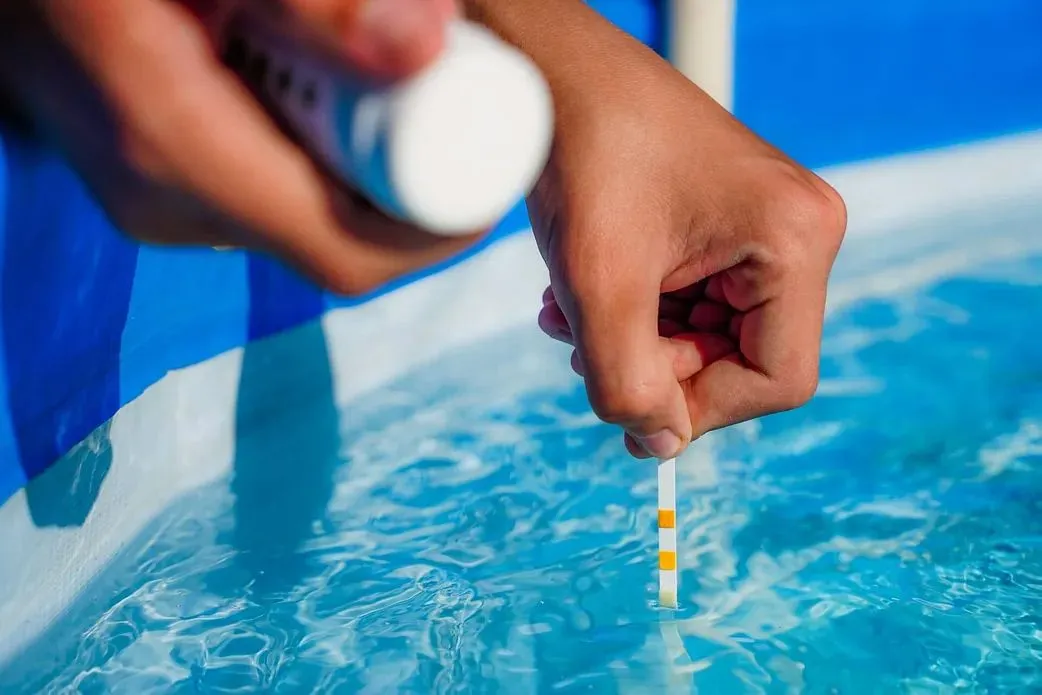
That's the practical service we offer. Bring in a sample and you get the readings explained, a dose worked out to your pool's actual volume, and an order of operations. It matters more here than most places, because small pools respond dramatically to small doses, and the classic Alex problem is a pool that's been over-corrected twice in a week and is now further from balance than when it started.
The Maroochydore shop trades from Kayleigh Drive, Buderim.
Work from volume, not from the bottle. Length × width × average depth in metres × 1,000 gives you litres, and every dose we recommend is calculated against that figure. Small Alexandra Headlands pools overshoot easily — a full label dose intended for a large backyard pool can push a courtyard pool well past target. Bring your dimensions and a water sample and we'll do the maths with you.
Almost certainly alkalinity. Total alkalinity is the buffer that holds pH steady, and in small pools it gets stripped by rain dilution and repeated acid dosing. Once it's low, pH swings on every small addition. Correct the alkalinity first, let it circulate, then adjust pH — in that order. It's the most common fix we make for pools in this suburb.
Yes, and it's a common situation along Alexandra Parade. We'll test your water, write out a simple weekly routine any committee member can follow, and supply pool chemical supplies in quantities that suit a small shared pool. If your committee would rather hand it over entirely, see body corporate pool servicing. Note that shared pools can carry testing and record-keeping obligations depending on how they're used — worth confirming for your building.
Usually the filter, not the chemistry. Many pools attached to older Alexandra Headlands blocks still run their original sand filters, and sand loses its ability to trap fine particulate after roughly five to seven years. A clarifier will help briefly, but if the media hasn't been changed in a decade, that's the actual fix. Bring photos of the filter and we'll tell you what you're looking at.
Weekly through the cooler months, and twice weekly over summer or after heavy rain. This stretch of coast is fully exposed to UV with very little shade, so chlorine burns off faster than it does inland, and small pools show the effect sooner. Test before dosing rather than after — it's the cheapest habit in pool care and it prevents most over-correction.
Not different products, but different priorities. Stabiliser matters more because UV exposure is unshaded, and if you're on a salt system, salt cell scaling and calcium hardness both need watching. Wind-blown sand and organic matter also load the filter more than inland pools. Bring a sample in and we'll test the coastal-relevant parameters, not just chlorine and pH.
Alexandra Headlands takes its name from the headland at its southern end and developed as a beachside holiday spot well before the surrounding coast filled in — its surf club, established in the 1920s, is among the older clubs on the Sunshine Coast. Growth came steadily through the mid-twentieth century in the form of low-rise flats and holiday units along the beachfront rather than large-scale resort development, and much of that 1960s–1980s building stock is still standing today. That history explains the suburb's pools: numerous, small, shared and often as old as the buildings around them, which is exactly the profile our pool chemical supplies and testing service are set up for.