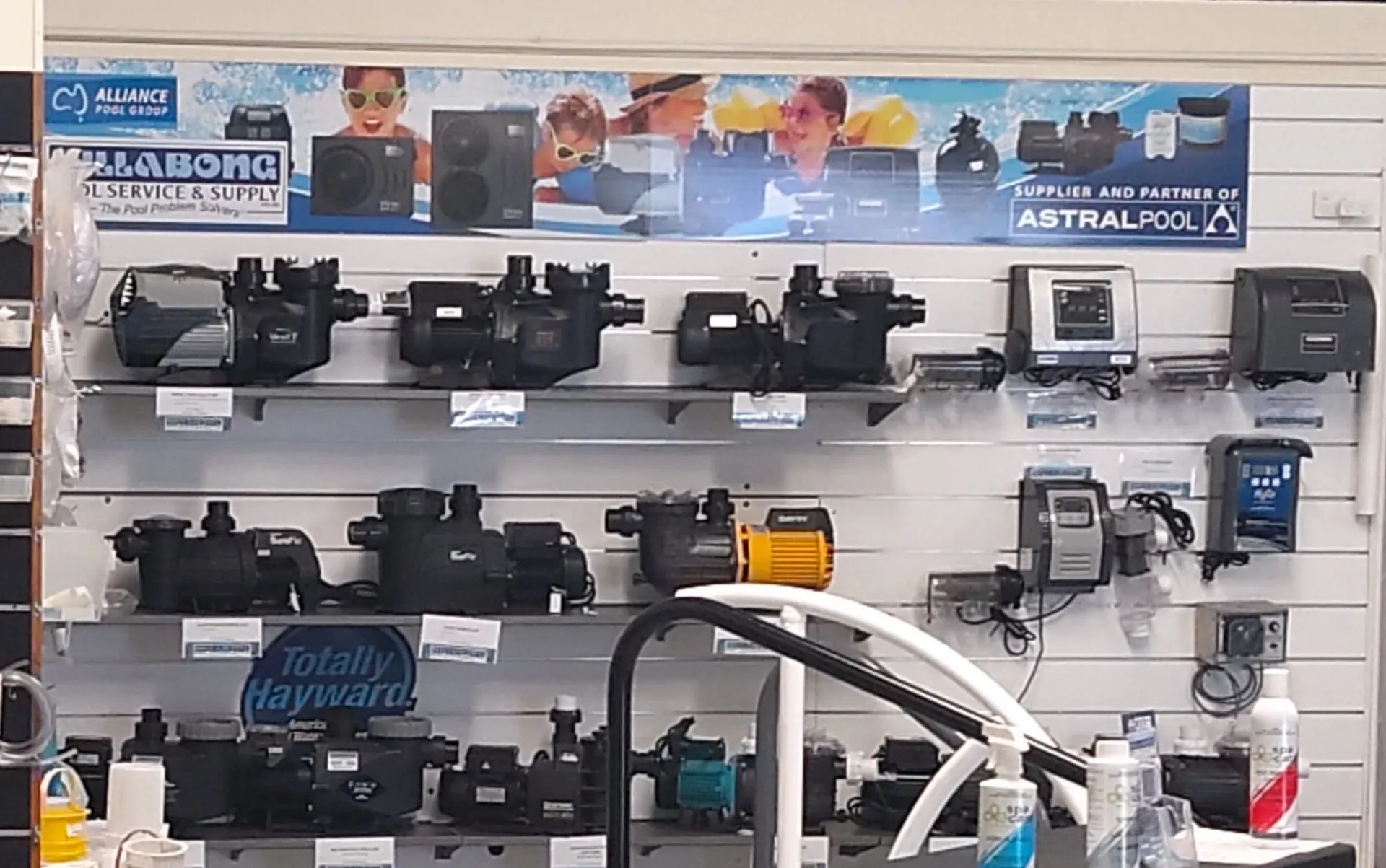
Pool chemicals, test kits and chlorinator parts on the shelves of a Billabong Pool Service & Supply shop on the Sunshine Coast

Pool Chemical Supplies Sunshine Coast

Sunshine Coast Region · Noosa Shire, QLD

Every chemical on the shelf is arithmetic, and the counter does the sum

Chlorine, salt, stabiliser, balancers, clarifiers and algaecides from the Caloundra, Maroochydore and Noosa counters, sold to a water reading and your pool's volume rather than to a label

Billabong stocks the chemical range at all three of its counters: 134 Bulcock Street in Caloundra, 7 Kayleigh Drive in Buderim for the Maroochydore side of the coast, and 20 Rene Street in Noosaville. Each runs an in-store water test, and the advice that follows starts from two numbers the label cannot know: what the water reads today, and how many litres the pool holds. This page is the front door to the range across the coast, and to the suburb pages beneath it.

A label dose is written for a pool the label's author imagined. Yours is bigger or smaller, saltier or softer, in the sun or under a cover, and the same scoop that holds a large pool for a week overshoots a small one by lunchtime. The correction then overshoots the other way, and a week later the water is further from balance than when it started. That is the pattern behind most of the water the counters are asked to rescue, and it is why every product here is sold with two questions first: what does the pool read, and how many litres is it?

The coast moves the readings. Mean daily maximums at Sunshine Coast Airport run from 21.2 °C in July to 29.1 °C in January, and UV strips free chlorine faster the warmer and brighter the month, so a dose that held in June is gone by the afternoon in December unless stabiliser is protecting it. The airport averages 1,492.6 mm of rain, 710 mm of it between December and March, and a big fall dilutes the pool, drops alkalinity and pH and spends sanitiser on the debris it washes in. None of that is visible from the pool deck, which is the whole argument for testing before dosing.

Local knowledge

Why it matters here

Pool chemistry is a sequence, not a shopping list. Alkalinity is corrected first because it steadies pH; pH second, because sanitiser only works in its range; calcium hardness is brought up so soft water stops drawing calcium out of a rendered or pebble interior; then chlorine or salt, then stabiliser to protect it; clarifier and flocculant last, once the water is balanced enough for them to work. Adding the right products in the wrong order is the most common reason a pool will not come good, and it is the thing a bottle cannot tell you.

The suburb pages beneath this one take one part of that each. Alexandra Headlands is written around small pools that punish a generous dose, with chlorine in small-pool quantities, alkalinity and pH correction, calcium hardness, and stabiliser and salt for open coastal exposure. Mooloolaba, Maroochydore, Buderim, Kawana Waters and Parrearra cover the rest of the Maroochydore side. On the Caloundra and Noosa sides the same range is sold from the supply shop pages, which is where those chips lead.

The chemical pages, from the Maroochydore counter

7 Kayleigh Drive, Buderim · 07 5443 2111

The range from the Caloundra counter

134 Bulcock Street, Caloundra · 07 5438 1588

What owners bring us

Common local challenges

The challenge

Chlorine demand that moves with the month

Why it happens

UV breaks down free chlorine, and daily maximums climb from 25.8 °C in October to 29.1 °C in January. The requirement rises through spring and peaks with the storm season; the product does not change, the quantity does.

Why it matters

Owners read it as chlorine that has failed and buy more of it, or buy a summer's worth in October and dose with something weaker than the label says by February, because liquid chlorine loses strength in storage, faster in heat and light.

How we help

Chlorine, salt and stabiliser sized to the reading and the month at all three counters, and a straight answer on what is worth buying ahead (chlorine and salt) and what is not (specialty products that degrade on the shelf).

The challenge

Stabiliser doing the opposite of what the owner thinks

Why it happens

Stabiliser shields chlorine from UV, so more feels safer. It is not consumed and does not evaporate, so on a pool that is topped up rather than drained it only accumulates.

Why it matters

Past a certain level it locks the chlorine up instead of protecting it: the pool tests as sanitised and behaves as though it is not, and no amount of chlorine fixes a stabiliser problem.

How we help

Stabiliser is part of every profile the counters run, so the problem is named rather than dosed around. The fix is dilution and patience, and we say so.

The challenge

Balance before sanitiser

Why it happens

Alkalinity and pH drift with rain, top-up water and heavy use, and sanitiser added to unbalanced water is wasted or made harsh. After a storm the order is the whole job.

Why it matters

Chlorine poured into water with the wrong pH does not sanitise it, and the owner buys more chlorine to chase a pH problem.

How we help

Buffers and pH correction sold with the sequence written down: alkalinity, then pH, then calcium, then sanitiser, then stabiliser, clarifier last.

The challenge

Calcium hardness nobody watches

Why it happens

Calcium drifts quietly through the year, and soft water is invisible until it has drawn calcium out of a rendered or pebble interior; hard water scales a salt cell and the waterline instead.

Why it matters

A surface repair costs more than every balancer on this page, and a scaled cell stops making chlorine.

How we help

Calcium hardness is read at the counter, the two readings home kits get least reliably being stabiliser and calcium, and treated before it reaches the surface or the cell.

The challenge

The dose is arithmetic

Why it happens

A plunge pool and a body-corporate pool can differ tenfold in volume, and a label written for one is wrong for the other by the same factor. Most owners have never measured their pool.

Why it matters

The small pool overshoots and is corrected back and forth; the large pool is under-dosed for weeks and turns.

How we help

Bring the pool's length, width and depths, or the volume if you know it. The counter works the dose for your litres, not the label's.

The challenge

Recovery in the right order

Why it happens

A pool that has turned after a storm, a winter shutdown or a change of owner needs shock, clarifier, flocculant and filtration in sequence, and the sequence matters more than the products.

Why it matters

Flocculant before the filter is ready, or algaecide before the chlorine has done its work, wastes both and leaves the pool where it was.

How we help

Recovery products sold as a plan: what goes in, in what order, with what pump and filter run between steps.

What we do

Services and stock

Chlorine and salt

Liquid, granular and stabilised chlorine, and salt for chlorinator pools, sized to the reading and the month rather than to the shelf.

The three ways to sanitise a pool are not interchangeable; the Dicky Beach page is written around choosing between them.

Salt, liquid or stabilised, Dicky Beach

Stabiliser

Cyanuric acid for pools that lose sanitiser to open coastal sun, tested before it is sold because too much locks the chlorine up.

The Alexandra Headlands page covers stabiliser and salt for open coastal exposure, in small-pool quantities.

Stabiliser, Alexandra Headlands

Alkalinity and pH balancers

Buffers and pH correction sold with the sequence written down, for the drift that rain, top-up water and heavy use put into every pool here.

The Currimundi page is written around buying for the season the pool is actually in, balancers included.

Balancers, Currimundi

Calcium, scale and staining

Calcium hardness treatment for soft water, and sequestering agents, scale and stain treatments for problems that sit on the surface rather than in the water.

The Golden Beach page is written around identifying a stain before treating it.

Scale and staining, Golden Beach

In-store water testing

A bench profile at any of the three counters: pH, chlorine, alkalinity, stabiliser, calcium hardness and salt, with the dose worked for your pool's volume.

Bring the sample in a clean sealed container the same day, and the pool's dimensions.

Find your nearest counter

Recovery products

Shock, clarifier, flocculant and algaecide for a pool that has turned, sold as a sequence with the pump and filter runs between steps.

The Moffat Beach page is written around recovery as a sequence where the order matters more than the products.

Recovery in order, Moffat Beach
Who does the work

Credentials and cover

Billabong Pool Service & Supply is family owned and publishes ABN 63 010 047 239 and QBCC Licence No. 69021 in the footer of every page on this site. The counters, the cleaning rounds and the repair team work from the same three addresses, so a reading that turns out to be an equipment fault is booked with the same people who sold the chemical. Billabong does not issue pool safety certificates and does not perform pool safety inspections; that is a licensed pool safety inspector's work.

Pricing

What we list

Where to find us

Three shopfronts on the Sunshine Coast

Good to know

Frequently asked questions

What order do I add pool chemicals in?

Alkalinity first, then pH, then calcium hardness, then chlorine or salt, then stabiliser, and clarifier or flocculant last once the water is balanced. Adding the right products in the wrong order is the most common reason a pool will not come good.

How much should I dose?

That depends on two numbers: the reading and the volume. Bring a water sample and the pool's length, width and depths (or its volume if you know it) and the counter works the dose for your litres. A label dose is written for a pool the label's author imagined, and a small pool reacts to it about three times as hard as a large one.

Should I stock up on chemicals before summer?

Chlorine and salt, yes: you will use them and buying larger is cheaper. Specialty products such as flocculant are better bought when needed; several degrade in storage and you may not need them at all.

Does liquid chlorine lose strength?

Yes, steadily, and faster in heat and light. A summer's worth bought in October is weaker than the label says by February. Buy chlorine in the quantity you will use within a few weeks, and keep it cool and out of the sun.

What is stabiliser for, and can I have too much?

It shields chlorine from UV; without it, summer sun here strips free chlorine within hours. Too much locks the chlorine up so the pool tests as sanitised and behaves as though it is not, and no amount of chlorine fixes that. It is tested, not guessed, and the fix for too much is dilution.

Do you test water, and at which shops?

Yes, at all three: Caloundra, the Maroochydore shop at Kayleigh Drive in Buderim, and Noosa at Rene Street, Noosaville. Bring the sample in a clean sealed container, taken at elbow depth away from the skimmer and return, the same day.

Which chemicals should not be stored together?

Chlorine and acid, kept apart, cool, dry and ventilated, in their original containers, and never on a balcony in the sun. The Kings Beach page is written around storing bulk chemicals safely in a unit block; ask at the counter for the storage advice that fits what you buy.

Next step

Bring a water sample and the pool's dimensions to the nearest counter and buy only what the numbers call for. Caloundra is on 07 5438 1588, the Maroochydore shop at Kayleigh Drive, Buderim on 07 5443 2111, and the Noosa shop on 07 5449 7855. All three trade Monday to Friday 8:00am to 4:30pm and Saturday 8:00am to 12:00pm.

References

Sources

Bureau of Meteorology — climate statistics, Sunshine Coast Airport (station 040861)Mean maximum 29.1 °C January, 25.8 °C October and 21.2 °C July; mean annual rainfall 1,492.6 mm with 710 mm December to March (sum of the four monthly means)
Billabong Pool Service & Supply — Pool Chemical Supplies in Sunshine Coast (the page this record updates)The client's own range and framing before this uplift: liquid chlorine to specialty algaecides; stabilisers, chlorine, pH buffers and algaecides as the core range; "warm weather and strong UV rays quickly reduce chlorine levels"; coastal wind, humidity and salt air
Billabong Pool Service & Supply — Pool Chemical Supplies for Alexandra HeadlandsSmall pools react to a dose about three times as hard as large ones; chlorine in small-pool quantities, alkalinity and pH correction, calcium hardness treatment, stabiliser and salt for open coastal exposure, in-store water testing (live pack page)
Billabong Pool Service & Supply — site footerABN 63 010 047 239; QBCC Licence No. 69021; the three addresses, phones and trading hours